E-2 Visa · Pro Forma Balance Sheet · 2026
How to Prepare a 5-Year Pro Forma Balance Sheet for an E-2 Visa (2026 Guide)
This guide explains, at a high level, how founders and treaty investors can structure a 5-year pro forma balance sheet for an E-2 visa business plan, what consular officers generally review, and in which situations professional accounting support may be appropriate.

1. What Is an E-2 Visa Pro Forma Balance Sheet?
For E-2 visa purposes, a pro forma balance sheet is a forward-looking statement that shows what your business is expected to own (assets), owe (liabilities), and retain (equity) over a defined period — often five years. It is usually included as part of the written business plan submitted with your application.
In the E-2 context, the balance sheet is not a tax filing or an audited financial statement. Instead, it is a structured way to demonstrate the financial shape of the enterprise, the level of capital you have committed, and how that capital is expected to be deployed.
The U.S. Department of State's treaty investor framework (discussed in the Foreign Affairs Manual at 9 FAM 402.9) focuses on whether the investment is substantial and whether the enterprise is more than marginal. Separately, U.S. immigration guidance often refers to the concept of marginality—that is, whether the business is expected to generate more than minimal living income for the investor and their family over time.
A clearly prepared pro forma balance sheet helps support these points by showing the structure of your investment and the assets that will be available to operate the business.
2. What Consular Officers Typically Review
When reviewing E-2 cases, consular officers generally look at the overall record rather than any single document. The balance sheet is usually evaluated alongside your business plan narrative, supporting documents, and evidence of funds.
Key themes they may consider include:
- Substantial investment: Whether the amount you have invested (or irrevocably committed) is meaningful in relation to the total cost of purchasing or creating the business.
- Business viability: Whether the projected financial position suggests the enterprise can operate as a real, active, and operating commercial undertaking.
- Non-marginality: Whether the business is expected, over time, to generate more than minimal income for the investor and to support some level of U.S. job creation or broader economic impact.
- Logical internal consistency: Whether the numbers on your balance sheet are internally consistent and aligned with the revenue, expense, and hiring assumptions in the rest of the business plan.
Publicly available guidance, including the U.S. Department of State Foreign Affairs Manual at 9 FAM 402.9, discusses these concepts at a policy level. However, each consular post may apply the standards in its own way, and adjudications are inherently discretionary. This guide is intended as general educational information and not as case-specific advice.
3. Core Components of an E-2 Pro Forma Balance Sheet
While formats vary, most E-2 pro forma balance sheets include the same three categories: assets, liabilities, and equity. Below is a common structure and how each item is typically used.
Assets
- Cash investment: Funds you have already transferred into the business account or escrow, available to pay startup expenses and operating costs.
- Equipment: Tangible property such as machinery, computers, point-of-sale systems, or specialized tools necessary to run the business.
- Inventory: Goods held for sale or materials that will be consumed in providing your product or service.
- Leasehold improvements: Build-out costs, furniture, fixtures, and other improvements to a leased space that are capitalized rather than expensed immediately.
Liabilities
- Business loans: Formal obligations to lenders or investors that must be repaid over time, such as bank loans or shareholder loans.
- Credit obligations: Short -term obligations such as credit card balances or trade payables related to inventory and operating expenses.
Equity
- Owner capital contribution: The amount you have personally invested in the business, typically reflected as equity or paid-in capital.
- Retained earnings (projections): The portion of future profits that are expected to remain in the business instead of being distributed, supporting growth and reserves.
However your balance sheet is formatted, the relationship Assets = Liabilities + Equity should hold for each projected year.
4. How to Structure a 5-Year E-2 Balance Sheet Projection
Many E-2 business plans include a five-year view so adjudicators can see how the enterprise is expected to evolve beyond the first year of operations. A common approach is to build the projection in stages.
- Year 1 snapshot: Reflect the immediate post-investment position—cash deployed, equipment purchased, initial inventory, and any startup liabilities.
- Growth assumptions: For Years 2–5, adjust assets and liabilities based on reasonable growth assumptions that are consistent with your revenue and headcount projections.
- Depreciation treatment: Longer-lived assets such as equipment and leasehold improvements are often depreciated over time, which reduces their book value on the balance sheet while affecting retained earnings through the income statement.
- Maintaining balance: As you update assets and liabilities, ensure that equity (including retained earnings) is adjusted so that the fundamental balance sheet equation continues to hold in each projected year.
The goal is not to predict the future with precision, but to show a plausible, coherent financial trajectory that aligns with your business narrative.
5. Common Issues Seen in E-2 Pro Forma Balance Sheets
Applicants preparing their own projections frequently encounter similar issues. Being aware of them can help you improve clarity and consistency.
- Math inconsistencies: The totals for assets, liabilities, and equity do not reconcile, which can raise questions about reliability.
- Missing depreciation: Long-lived assets are not depreciated in later years, leading to unrealistically high book values.
- Overly optimistic projections: Growth rates and profitability that are not supported by the underlying market description, staffing plan, or capitalization level.
- Inconsistent labeling: Line items are named differently across years or do not match the terminology used in the income statement and cash flow projections.
- Missing disclaimer language: Projections are presented without clarifying that they are unaudited, forward-looking estimates prepared for planning purposes.
6. DIY Excel, CPA Support, and Automated Tools: A Neutral Overview
There is no single correct way to prepare an E-2 pro forma balance sheet. Founders generally choose among three approaches, or a combination of them, depending on budget, timeline, and comfort with financial modeling.
| Option | Potential Advantages | Potential Limitations | Typical Use Case | Approximate Cost |
|---|---|---|---|---|
| DIY spreadsheet (Excel or similar) | Full control over assumptions and formatting; no third-party fees if you already have spreadsheet software. | Requires comfort with formulas and basic accounting concepts; errors may be harder to detect without a second review. | Founders with strong spreadsheet skills who prefer to build their own model from scratch. | Primarily time investment; software license if needed. |
| Certified Public Accountant (CPA) | Professional accounting expertise; ability to align projections with tax and financial reporting practices. | Higher cash cost; may require several days or weeks of turnaround time depending on the practitioner's workload. | Applicants who prefer professional preparation, have more complex financial structures, or whose attorney recommends CPA involvement. | Varies by provider; often several hundred dollars or more for planning-level projections. |
| Structured automated tool (such as Flowwork) | Guided question-and-answer flow; automatic calculations and formatting; designed specifically around pro forma structures used in immigration business plans. | Still requires you to supply reasonable inputs and review results; does not replace individualized legal or tax advice. | Founders who want a structured starting point quickly and plan to review or customize the output with their immigration counsel or advisor. | Typically a modest one-time fee per generated plan (for example, around USD $9.90). |
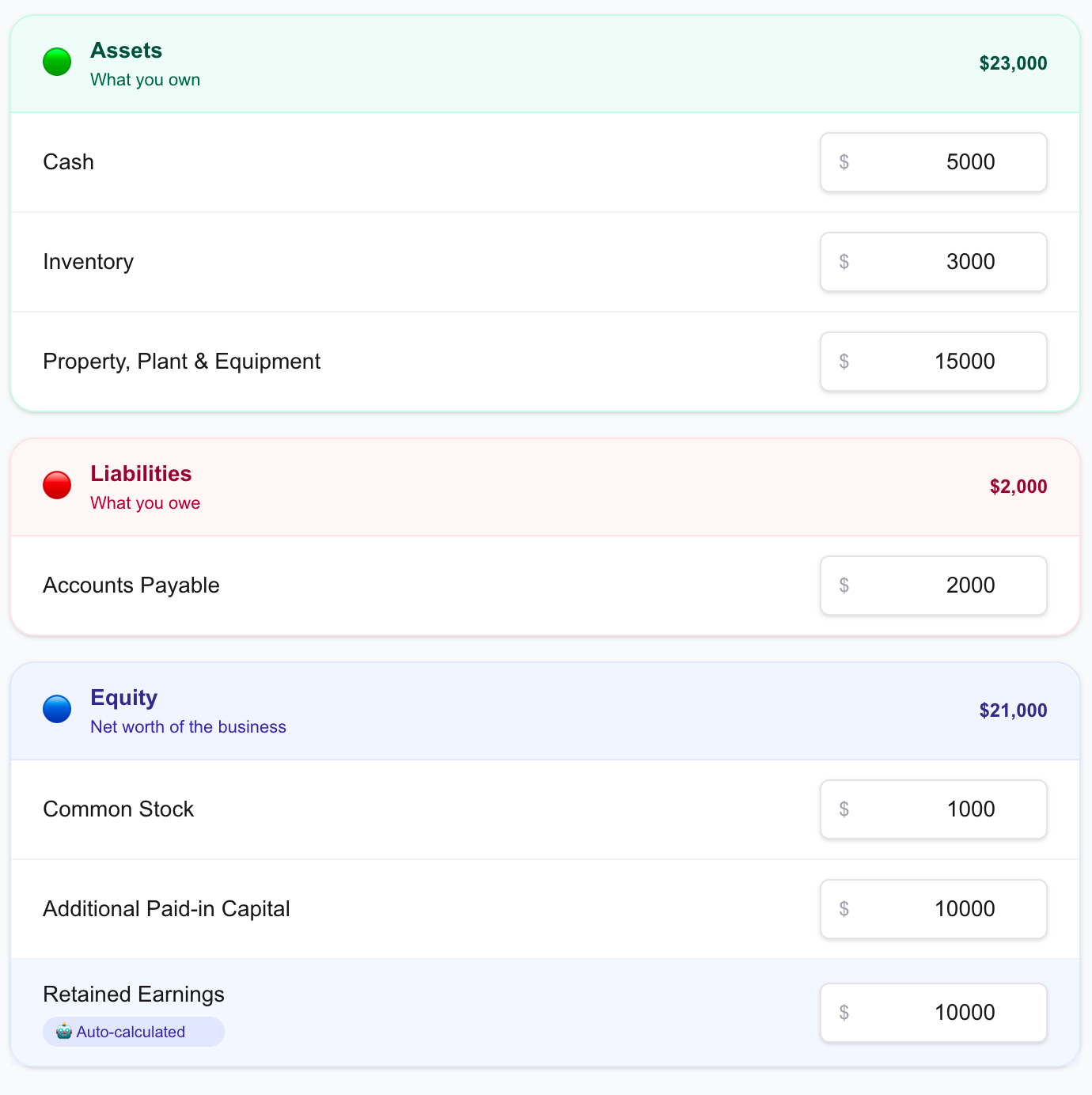
None of these options is inherently "best" for every case. Many applicants combine approaches—for example, starting with an automated template or spreadsheet and then asking their immigration attorney or accountant to review the structure.
7. When Professional Accounting Support May Be Appropriate
Pro forma balance sheets prepared for an E-2 business plan are often unaudited management projections. However, there are situations where working with a licensed accountant or other professional may be advisable.
- Your immigration attorney has specifically requested CPA-prepared or CPA-reviewed financial statements.
- Your corporate or tax structure involves multiple entities, complex financing arrangements, or jurisdiction-specific considerations.
- You plan to use the same projections when applying for bank financing or presenting materials to third-party investors.
- You are uncomfortable interpreting the impact of depreciation, taxes, or retained earnings on multi-year projections.
Because E-2 adjudications are fact-specific, it is important to discuss your approach with your immigration attorney. A useful, neutral question to ask is whether unaudited pro forma financials are appropriate for your initial filing in light of the facts of your case and the expectations of the consular post involved.
This guide is for general informational purposes only. It does not constitute legal, tax, or accounting advice, and it does not create an attorney–client or advisor–client relationship.
8. About Flowwork and Balance Sheet AI
Flowwork's Balance Sheet AI tool was created for startup founders and treaty investors who need structured, immigration-ready financial projections without building every schedule from a blank spreadsheet.
- Focused on organizing inputs into clear, consistent pro forma balance sheet structures.
- Designed for use alongside, not instead of, professional legal and tax advice.
- Built with international founders and cross-border business plans in mind.
Flowwork is not a law firm and does not provide legal representation. Any immigration strategy, including how you present your financial projections, should be developed in consultation with a qualified immigration attorney familiar with your specific facts.
If you have questions about how the tool structures balance sheets or how it may fit into your overall workflow, you can reach the team at getflowwork@gmail.com.
Generate a Structured E-2 Pro Forma Balance Sheet in Minutes
If you would like a structured starting point for your immigration business plan, you can use Flowwork's Balance Sheet AI to organize your inputs into a 5-year pro forma balance sheet format that you and your attorney can review together.